Sobu Capital exists for a particular kind of investor in a particular kind of market, and the way we work is what makes the difference.
Australian private markets have expanded rapidly over the last decade. Platforms aggregate access. Funds gather scale. Distributors push product. Each has a structural incentive that pulls a certain way: platforms compete on breadth, funds on capital raised, distributors on placement volume.
Sobu doesn’t compete in any of those places. We are investor‑first, not a distributor. What we compete on, quietly, and with a small group, is selection: which opportunities are worth a like‑minded network seeing, and which aren’t. What reaches our network is what the founder has personally backed with the family’s own capital. The value isn’t the flow; it’s the filter.
That stance shapes everything that follows.
Investor first, in practice
“We invest our own capital alongside” can sound like a slogan. It isn’t.
Sobu is run by a former multi‑asset portfolio manager whose broader‑family capital is already deployed across Australian private markets, roughly twenty positions with fifteen managers, generating a blended projected yield of around 9.4% per annum. The portfolio is predominantly private credit (the income engine), with a meaningful private equity sleeve and a selective venture allocation. Most positions distribute monthly; the income orientation is real, not theoretical.
Several manager relationships are multi‑position, backed two or three times across different funds and entities. That repeat‑conviction pattern is what distinguishes a selector’s portfolio from a platform user’s: conviction sized up over time, not breadth sized down through a marketplace.
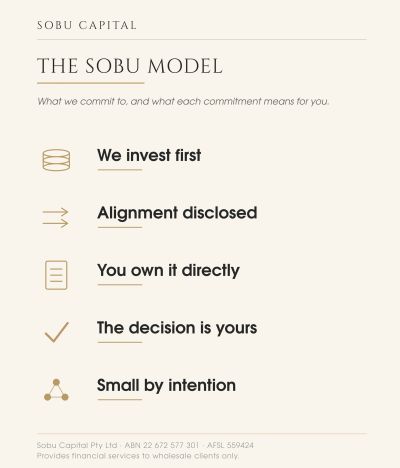
Opportunities shared with our network are ones Sobu has assessed for the family’s own capital first. If a manager or a deal doesn’t clear that bar, it doesn’t reach the network. The opportunities an investor is invited to commit to are, in most cases, ones we have already invested in ourselves.
Alignment matters because it imposes a real cost on misjudgement. We pay for our own mistakes alongside our network. There is no version of the model where we win on flow while our network loses on selection.
What gets shared, and what doesn’t
Most things get a no. That’s the design.
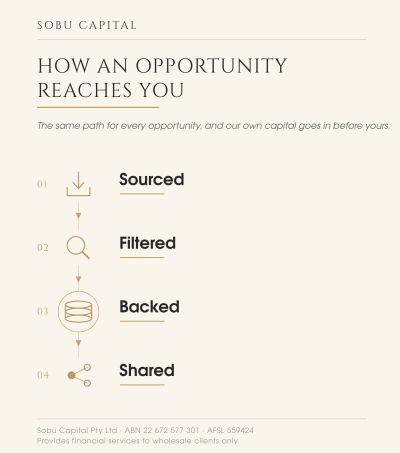
The funnel is consistent. A manager, warm‑introduced or inbound, opens a conversation. We engage as an investor: ask substantive questions, request the materials we would want for our own capital, and run the diligence we would run for ourselves. If the opportunity is one we would commit family capital to, on terms that hold up for the end investor, we proceed. If not, we decline, no entanglement, no obligation, no pressure to pursue a referral conversation we don’t believe in.
When something does proceed, sizing reflects conviction, not formula. Family positions span a wide range, from exploratory tickets well under one percent of the portfolio to materially larger commitments when the analytical basis warrants it. Our network sees the same signal: how Sobu sizes into an opportunity reflects the strength of the call.
We are also honest about realised mistakes. Every long‑standing private markets book has them. One early family position, pre‑Sobu, was an equity stake taken on the strength of a “double‑digit income” promise via proximity, with no diligence machinery and no governance access. It ended up close to zero. We keep it on the list because it embeds the exact failure pattern Sobu’s process is built to prevent: proximity‑led decisions, equity dressed as income, conviction borrowed rather than earned.
Independence and how we handle conflicts
Independence is built into the structure. Sobu manufactures nothing.
We don’t operate a fund, structure a product, or hold inventory. The only honest question on every opportunity is whether it is good for the investor, there is no parallel question of whether we need to clear our own shelf.
Where economics flow, they flow from the manager to Sobu on disclosed terms, referral or trail arrangements documented in written agreements and disclosed to every wholesale client every time. Full disclosure is the floor, not the ceiling.
One long‑standing relationship with an Australian private credit manager involved the founder serving as a director from 2024. That role provided direct governance visibility and the analytical basis for the family’s larger‑than‑average position. As Sobu evolved into an independent selection business, the tension between that directorship and an “investor‑first, independent selector” identity became live.
The founder raised it early; the path forward has been worked through cooperatively. The directorship will be stepped down, the relationship will convert to an arm’s‑length referral agreement, and the position will rebalance over time as visibility reduces. Visibility justified the size; reduced visibility implies reduced size.
We record that arc because it is the right way to handle this kind of tension: name it, work through it, and let the structure speak for itself.
Two hats, separated by structure
Two structural facts matter.
First: Sobu Capital holds AFSL 559424, with authorisations to provide financial product advice and arranging services to wholesale clients across managed investment schemes, securities, derivatives, foreign exchange and government debt. We do not issue financial products, operate a managed investment scheme, or provide a discretionary or managed‑account service. Each investor subscribes directly with the underlying manager.
Second: Sobu is the selector under the licence, and the introducer under any referral agreement with a manager. These roles are separated by structure and disclosed by default. Sophisticated investors understand the distinction; we treat the discipline of keeping them apart as part of what they are choosing to engage with.
Who Sobu is for
Sobu works for wholesale‑qualified investors, high‑net‑worth individuals and family offices who want a selector they can call rather than a marketplace to browse, who value depth over breadth, and who measure access by quality rather than quantity.
The network is small, and stays small. Capacity is a feature, not a problem. A small network keeps incentives aligned, one weak referral damages the entire relationship and keeps conversations substantive rather than transactional. Growth will be slow, by referral and trust, and will stop where additional members would dilute either the relationship density or the discipline.
How an engagement works
The sequence is simple.
We confirm wholesale qualification under the Corporations Act before sharing any opportunity. Once qualified, network members see what we see, a written opportunity memo, the manager’s materials, our assessment of the structure, the economics including any referral arrangement, and how the founder’s own capital is participating. Each investor makes their own decision, subscribes directly with the manager, and holds the position in their own name.
We say no to opportunities we don’t believe in. We say “this isn’t right for you” when something doesn’t suit an investor’s circumstances, even when it suits ours. Both are forms of credibility worth preserving.
What Sobu is not
Sobu is not a platform, we don’t run a marketplace or a product menu. Sobu is not a fund, we don’t pool capital or carry a continuous performance obligation. Sobu does not provide a discretionary or managed‑account service, every decision sits with the investor. Sobu does not provide personal financial product advice to retail clients, the licence and the network are wholesale‑only by design.
If you want breadth, scale, daily marks or a one‑stop shelf, Sobu isn’t it. If you want one trusted selector, a small group of like‑minded investors, and a discipline you can interrogate, that’s what we built.
We use cookies to analyze website traffic and optimize your website experience. By accepting our use of cookies, your data will be aggregated with all other user data.